
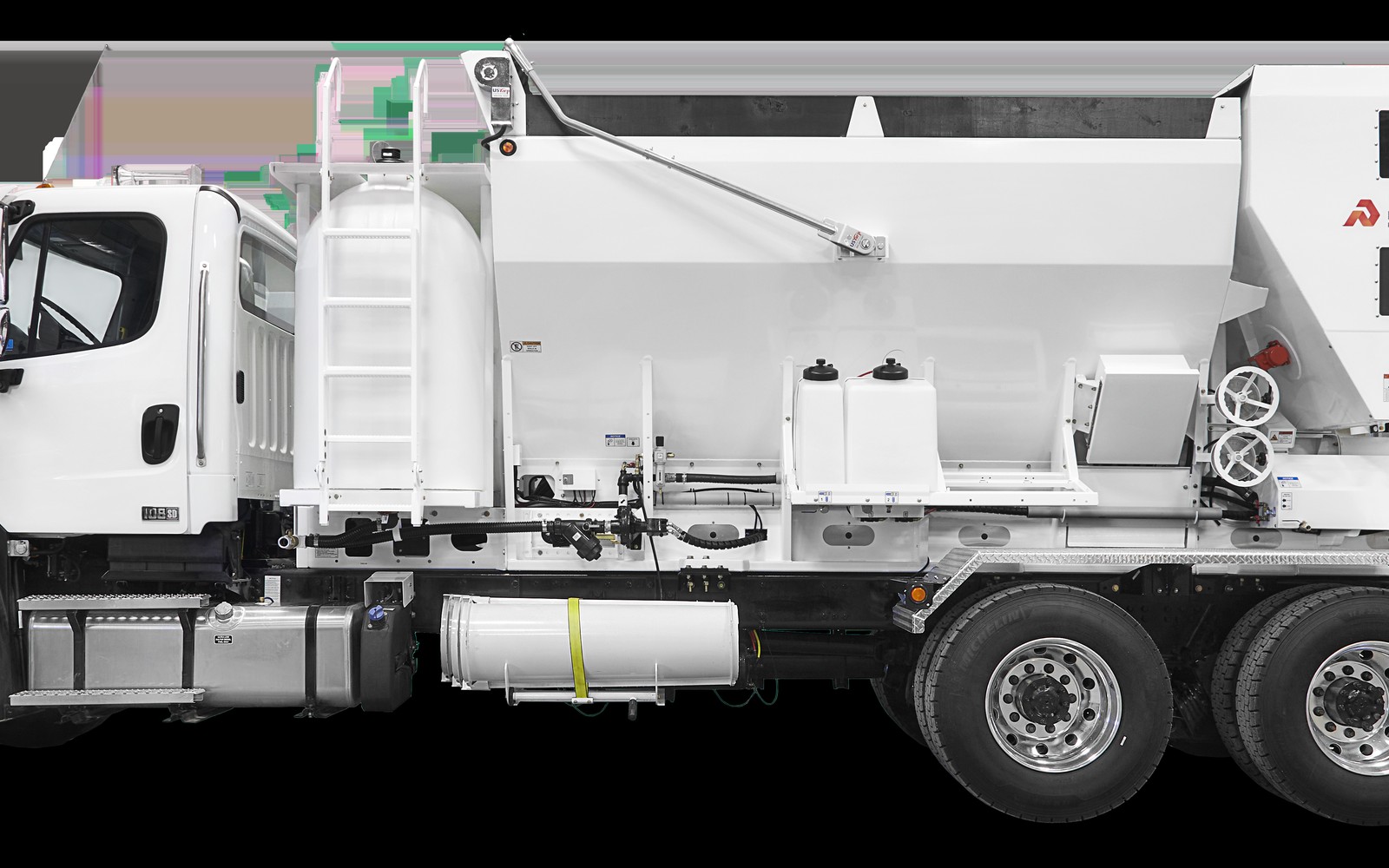
Bridge work puts concrete in places a drum truck cannot always reach. Below-grade cap pours for column formwork on a river crossing, approach slab placements where the shoulder is too narrow for a full-size transit mixer, wing wall pours at culvert replacements in confined cuts: these are the concrete tasks where plant concrete creates access and logistics problems that the contractor absorbs. A volumetric mixer built for bridge and infrastructure work arrives in the right form factor, batches at the structure, and avoids the access gymnastics entirely.
Infrastructure concrete also carries stringent mix design requirements. Bridge deck concrete, cap and column concrete, and approach slab mixes are often specified by the DOT or structural engineer of record with tight controls on water-cement ratio, air entrainment, and slump. A metered concrete mixer maintains those proportions with on-board metering accuracy that generates a paper trail the inspector can verify. That accountability is part of why infrastructure clients and DOTs are increasingly comfortable with volumetric supply on bridge work.
We finance volumetric mixers for bridge and infrastructure contractors with the speed that government contract timelines demand. Our minimum is $50,000, and production units for infrastructure work typically range from $100,000 to $150,000 and above. We work through both new and used equipment, including specialty configurations for shotcrete or high-strength mixes.
Specialized Configurations for Bridge and Infrastructure Pours
Infrastructure concrete work is not uniform. A contractor doing culvert replacements needs a different tool than one doing bridge deck pours, and both differ from a contractor doing pile cap work in a marine environment. Volumetric mixers are configurable for each of these applications in ways that batch plant trucks are not.
For shotcrete applications on concrete repair, slope stabilization around bridge abutments, or lining of drainage channels, a shotcrete volumetric mixer combines batching and pump-spray capability in one unit. Shotcrete work on infrastructure projects often happens in locations where conventional placement is impossible, and having the batch capability on site removes the last logistical constraint.
Contractors doing marine or water-adjacent infrastructure, bridge piers, sheet pile caps, bulkhead replacements, benefit from a volumetric unit because mix design for marine-exposure concrete requires exact water-cement ratio and admixture dosing that is difficult to verify when a drum truck arrives having traveled thirty minutes from the plant. On-site batching gives the contractor documented control over every variable the engineer specified.
For large bridge deck pours that use concrete paving mixes, a high-output volumetric mixer that can sustain production rates comparable to a batch plant delivery is the right tool. These units can typically produce eight to twelve yards per cycle on their largest configurations, keeping pace with placement crews on major deck pours.
Bridge and Infrastructure Contractor Profiles
Heavy civil contractors who hold DOT bridge repair contracts are the primary market for volumetric mixing on infrastructure work. These contractors work at remote sites, under traffic control, and with inspectors who require documentation on every batch. Volumetric metering provides that documentation automatically, which streamlines the inspection process compared to relying on plant batch records for trucks that left the plant forty minutes before the pour.
Utility contractors doing large diameter culvert installation, headwall construction, and junction box pours on major utility corridors are also strong candidates. Each structure requires concrete in specific quantities with specific mixes. Ordering plant concrete for each structure individually generates minimum load charges and timing friction that volumetric batching eliminates entirely.
Contractors in states with large rural highway networks, where bridge repair work is geographically dispersed and plant access is limited, have the strongest case for volumetric ownership. See how road and highway contractors use volumetric mixing to solve the same rural access problem across their general corridor work, and recognize that the bridge repair sub-specialty faces the same challenge in a more acute form.
Financing Infrastructure-Grade Volumetric Equipment
Bridge and infrastructure contractors are typically mid-sized to larger businesses with established bonding, documented government contract revenue, and multi-year operating histories. That profile is favorable for equipment financing, and most standard transactions in this sector move efficiently through underwriting.
An equipment loan structures the purchase with title in your name from closing, fixed payments over the term, and full depreciation eligibility. For a business with strong revenue and existing equipment paid down, this is usually the cleanest option. An equipment lease may be preferable when preserving balance sheet capacity for bonding ratios or letters of credit required on large contracts.
For specialty infrastructure units, particularly high-output or shotcrete-capable configurations, the purchase price may exceed the standard application-only threshold. In those cases, we move into conventional underwriting that looks at financial statements more fully, but we still target the shortest realistic timeline. A contract award does not extend its deadline while financing catches up.
We also finance used volumetric mixers purchased through private parties or equipment dealers. A used high-output unit from a retiring contractor can be a sound investment for an infrastructure company that wants to test the volumetric model without paying new-unit prices.
Documentation Typically Required
For infrastructure contractors with revenues in the typical range for their size, we generally work on application-only financing up to approximately $400,000. Three months of bank statements, the equipment quote or purchase agreement, and credit make up the core package. Transactions above that threshold move through a conventional package that includes financial statements.
B/C credit is workable even for infrastructure contractors, particularly if credit marks are isolated to a specific period rather than ongoing. The nature of government contract revenue, recurring and documented, carries weight in the underwriting conversation that general commercial credit scoring does not fully capture. We present the file to lenders who understand the construction credit profile, which matters in how the decision is reached.
Frequently Asked Questions
Bridge and infrastructure contractors ask us these questions most often.
Finance Your Infrastructure Volumetric Unit
Apply today. Bridge and infrastructure contractor applications typically complete the review in one to two weeks. Explore loan structures, consider a Sale-Leaseback on existing equipment, or reach out directly to discuss specialty units for your specific work scope. We move at the pace your contract timeline requires.