
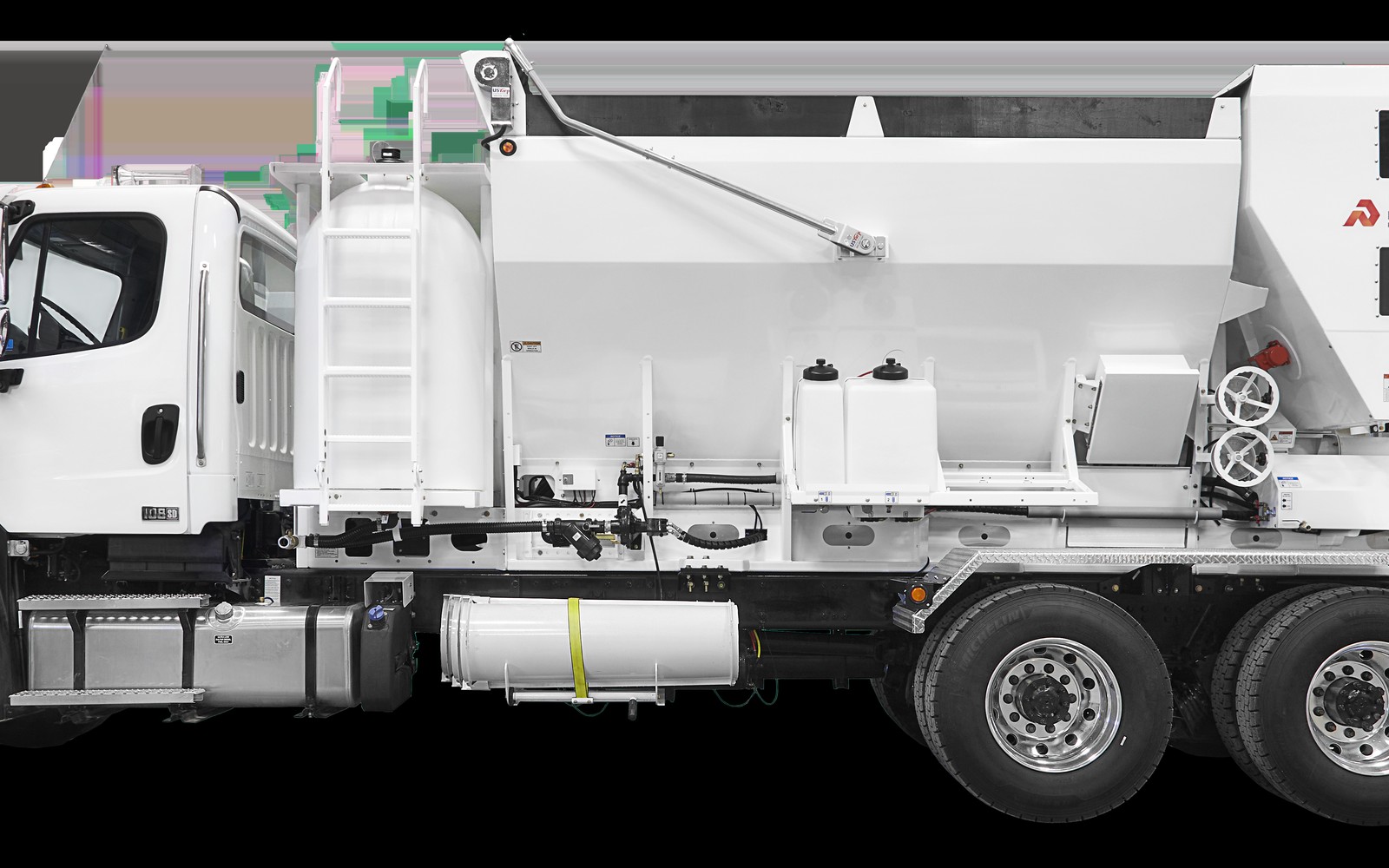
Government and military construction happens in places that commercial concrete supply cannot reach. Forward operating bases overseas, training range infrastructure in remote military reservations, border infrastructure projects, federal facility construction on restricted sites, and disaster response construction: all of these generate concrete demand in locations where calling a local batch plant is not an option. Contractors who win this work and then struggle to supply concrete are the ones who did not plan the logistics as carefully as they planned the bid. Contractors who bring a volumetric mixer to government work own that problem completely from the first day on site.
Military base construction work, particularly under contracts like MILCON and overseas contingency construction, requires that concrete quality be documented and the supply chain be under the contractor's control. A volumetric concrete mixer truck with metered documentation capability satisfies the quality documentation requirement while making the contractor fully supply-independent. That combination, quality documentation plus logistics independence, is what government contracting offices value in a construction team's concrete plan.
We finance volumetric mixers for military and government contractors. Our minimum is $50,000. Production units suitable for government construction work typically run $100,000 to $150,000 and above. We work with B/C credit situations, new and used equipment, and private-party transactions. Funding generally completes in about one to two weeks from a full application.
Government Construction Work That Demands Independent Concrete Supply
The categories of government concrete work where volumetric mixing has the strongest case are those where site access, remote geography, or security restrictions make plant delivery impractical. Military airfield pavement repair on a restricted installation, border crossing approach slabs in remote terrain, federal prison facility expansion in a rural location, and national park infrastructure construction where commercial truck access is limited: these projects share the characteristic that the concrete must come from inside the project envelope.
USACE (U.S. Army Corps of Engineers) construction contracts and similar government construction programs frequently include technical specifications for concrete that require mix design submittals and batch documentation. Volumetric metering produces the batch ticket data these specifications require. The fact that the concrete was batched on site rather than delivered from a plant does not impair that documentation; in many cases it improves it, because the batch was produced under the contractor's direct supervision rather than at a third-party plant.
Government contractors who self-perform concrete scope on large multi-year federal construction programs in western states, where project sites span remote geography in states like Nevada, New Mexico, or Wyoming, are in exactly the operating environment where volumetric batching is not a nice-to-have but a project delivery requirement. Contractors based in markets like Albuquerque, NM or Cheyenne, WY frequently pursue these federal contracts and need volumetric capability to be credible bidders on self-perform concrete scope.
Government Contractor Profiles That Use Volumetric Concrete
Primary federal construction contractors with MILCON or civil works contracts are the core market. A general contractor holding a military base construction contract that includes concrete buildings, hardstands, flight line aprons, and utility infrastructure has substantial concrete scope on a site where plant supply is unavailable or restricted. The prime contractor who self-performs concrete, or who has a sub with volumetric capability, runs that scope more efficiently and with better quality documentation than one who scrambles to find a plant delivery option.
Small business set-aside contractors who win 8(a), HUBZone, or SDVOSB construction contracts often do remote or specialized federal work. A small government contractor self-performing concrete work on a remote federal facility needs the same volumetric capability that a large prime needs, just scaled appropriately to the work volume. Our programs work for small contractors as well as large ones.
Emergency response and disaster relief contractors, those who mobilize under FEMA or other federal disaster contracts to restore infrastructure after hurricanes, floods, or other events, are another strong profile. Speed of deployment and supply independence are paramount in disaster recovery work. A contractor who can arrive on site with concrete batching capability on the truck is more capable than one who has to wait for the local supply chain to reconstitute. Compare this to the self-sufficiency model that rural and remote jobsite contractors use for similar access-constrained work in peacetime construction.
Financing Structures for Government Contractors
Government contractors typically have documented contract revenue, which is among the most favorable revenue types for equipment financing underwriting. Federal contracts are low credit-risk revenue from a counterparty that does not default. That profile, combined with the long-term nature of multi-year construction contracts, positions most government contractors well for equipment financing.
An equipment loan is the standard approach. You own the truck, depreciate it in the purchase year if you use Section 179, and build equity as the balance decreases. An equipment lease may be preferable if you are managing bid bond capacity or letters of credit for multiple concurrent federal contracts, where balance sheet presentation to the surety or bonding company matters.
Application-only financing up to approximately $400,000 is available for most established government contractors. Three months of bank statements documenting the government contract revenue, the purchase quote, and credit are typically sufficient to start and complete the review within one to two weeks. For larger transactions or more complex situations, we still work efficiently toward closure.
For contractors who own a volumetric unit outright and need working capital ahead of a large government contract mobilization, a Sale-Leaseback on the existing unit converts that equity to cash at closing. You keep the truck in service on the contract, and you have capital for mobilization costs, security deposits, and the upfront expenses that government contract work requires before the first payment application is approved.
Selecting Equipment for Government Work
Government construction has equipment compliance requirements that commercial work does not. EPA engine emission tier requirements, OSHA safety system requirements, and project-specific equipment approvals may apply depending on the contract. A volumetric unit purchased for government work should be specified with those requirements in mind.
For contractors doing large government construction with substantial concrete scope, a high-output volumetric mixer capable of sustained production across long pour days is appropriate. Government contracts often have incentive provisions for schedule acceleration, and a high-output concrete supply capability helps a contractor take advantage of those provisions.
For disaster response and emergency construction work where mobilization speed is the priority, a trailer-mounted volumetric mixer that travels on a flatbed or behind a work truck deploys faster than a dedicated truck-mounted unit and can reach sites with restricted access. The lower unit cost also fits the short-duration contract model common in emergency response work.
Government contractors doing classified facility construction or security-sensitive projects who need to source American-manufactured equipment should confirm manufacturer origins with their contracting officer. The Buy American Act and related provisions may apply to certain equipment on certain government contracts.
Frequently Asked Questions
Government contractors ask us these questions most often before financing a volumetric unit.
Finance the Concrete Supply That Government Contracts Demand
Apply today. Government contractor applications typically complete the review in one to two weeks. Explore loan options, consider a Sale-Leaseback on existing equipment for mobilization capital, or compare a lease structure for balance sheet management. Independent concrete supply is a government contract advantage and we help you finance it.